
 OC Apartment Brokers
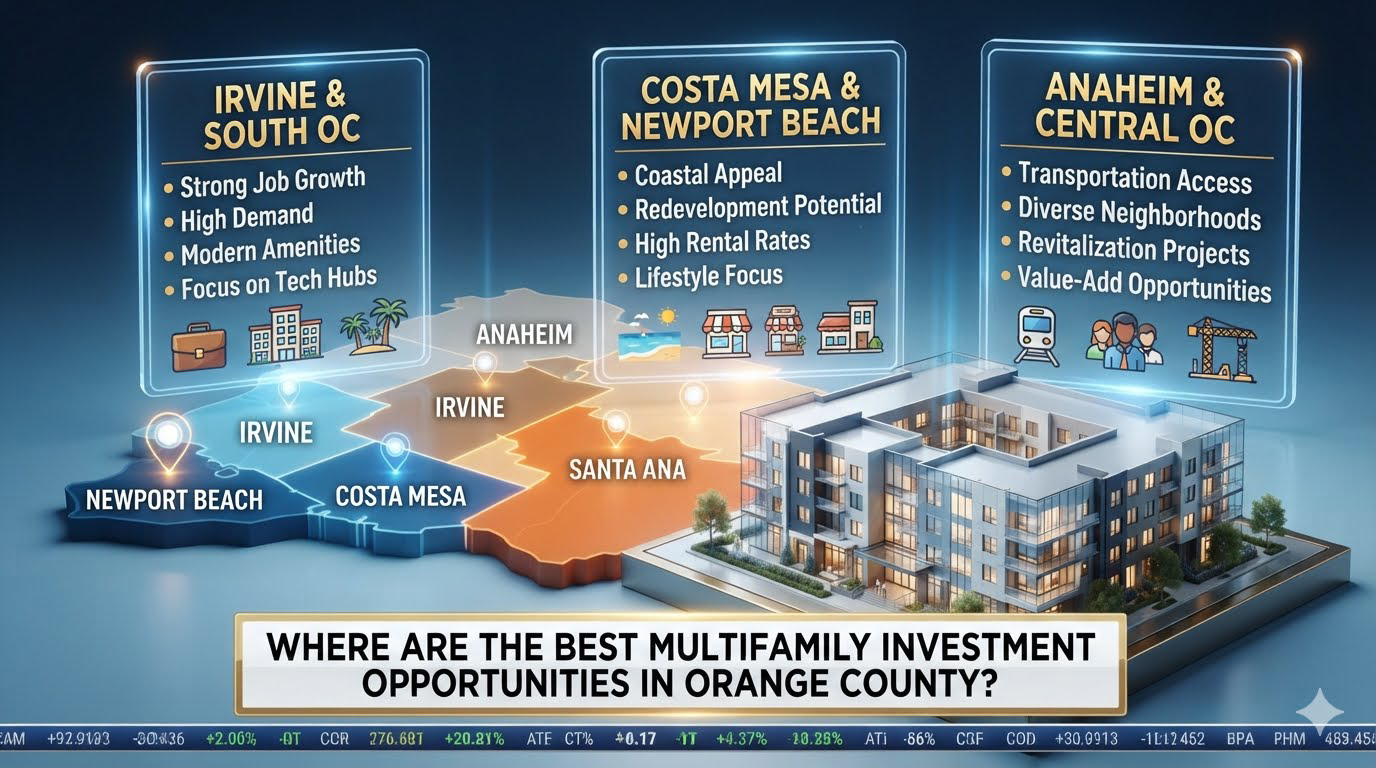
Where Are the Best Multifamily Investment Opportunities in Orange County?
When investors ask me, "Where are the best multifamily investment opportunities in Orange County?" they're usually expecting me to name a city.
But I don't think that's the right question.
There isn't one "best" multifamily market in Orange County.
The better question is:
Best for what?
The best opportunity for a cash-flow investor may be very different from the best opportunity for an investor looking for long-term appreciation, a value-add project, or a property with a lower barrier to entry.
Orange County is made up of very different multifamily submarkets. Coastal communities, established central Orange County markets and more affordable inland areas can offer completely different combinations of price, rent, vacancy, competition and upside.
So rather than simply ranking cities from #1 to #10, I think it's more useful to look at what makes a multifamily market attractive in the first place.
What Makes a Multifamily Market "Best"?
I would evaluate an Orange County multifamily market using six primary factors:
1. Acquisition pricing
How much capital does it take to acquire a property?
2. Rent levels and rent growth
What can an owner realistically collect today, and what is the potential for future rent growth?
3. Vacancy and demand
How strong is the tenant pool and how easy is it to keep units occupied?
4. Value-add potential
Is there an opportunity to increase rents, improve operations or reposition older properties?
5. Inventory and competition
Are there enough properties trading to create opportunities, or are investors competing for a very limited number of deals?
6. Barriers to entry
How difficult is it for an investor to achieve an acceptable return at today's prices?
The interesting thing is that no Orange County city scores highest on every category.
That's why the answer depends heavily on the investor.
Coastal Orange County: Strong Fundamentals, Higher Barrier to Entry
Cities such as Huntington Beach, Costa Mesa, Newport Beach and Laguna Beach offer many of the characteristics investors want:
- Strong tenant demand
- High rents
- Desirable locations
- Limited land
- Long-term supply constraints
- Strong quality-of-life characteristics
The problem?
Everybody knows it.
Coastal Orange County generally requires substantially more capital to acquire multifamily properties.
That creates a higher barrier to entry and can make it more difficult to achieve attractive going-in returns.
However, coastal properties can make sense for investors who prioritize:
Long-term appreciation + location + rental demand
rather than simply maximizing initial cash flow.
For these investors, paying more for a better location may be a feature rather than a problem.
Central Orange County: A Balance of Price and Demand
Markets such as Santa Ana, Garden Grove, Orange and Anaheim offer a different investment profile.
These communities have large renter populations, established apartment stock and a broad range of multifamily properties.
They also provide considerably more variety in terms of:
- Unit count
- Property age
- Price
- Rents
- Condition
- Value-add potential
This can create opportunities for investors who are willing to look beyond the newest or most attractive properties.
An older apartment building with below-market rents may have substantially more upside than a fully renovated property that is already achieving market rents.
For many investors, this is where the equation becomes interesting:
Moderate acquisition cost + strong renter demand + operational upside.
Anaheim: Scale and Variety Create Opportunities
Anaheim deserves special attention because of the depth and diversity of its multifamily market.
There are older smaller apartment properties, larger apartment communities, redevelopment opportunities and properties spread across very different neighborhoods.
That variety means investors can pursue very different strategies.
A smaller investor may focus on a fourplex with below-market rents.
A more experienced investor may look for a larger property where operational improvements can create meaningful additional value.
The challenge is that Anaheim is not one uniform market.
The specific neighborhood matters.
Two properties only a few miles apart can have very different tenant profiles, rents, physical characteristics and investment potential.
Santa Ana and Garden Grove: Value-Add Potential
For investors specifically looking for value-add opportunities, I would pay close attention to markets such as Santa Ana and Garden Grove.
These markets have significant older multifamily housing stock.
That can create opportunities where the existing owner has not fully captured the property's potential.
Potential improvements might include:
- Interior renovations
- Exterior improvements
- Better property management
- Utility expense management
- Parking optimization
- Laundry income
- Reducing vacancy
- Bringing rents closer to market
But there is an important distinction:
Value-add does not automatically mean good investment.
A property that needs $30,000 per unit of improvements isn't necessarily better than a property that needs $5,000 per unit.
The renovation cost has to produce enough additional income and value to justify the investment.
The More Affordable Markets: Lower Entry Cost, Different Tradeoffs
Investors looking for a lower acquisition price may also consider markets such as Fullerton, Buena Park, Westminster and parts of northern Orange County.
These markets can provide a different combination of:
- Lower purchase prices
- Established renter demand
- Older housing stock
- Value-add opportunities
- Access to major employment centers
The tradeoff is that lower acquisition cost doesn't automatically mean better investment performance.
Investors still need to evaluate:
Price relative to rents.
A $2 million property isn't necessarily a better deal than a $3 million property if the $3 million property generates significantly more income and has better long-term fundamentals.
What About Vacancy?
Vacancy is another factor that can easily be misunderstood.
A low vacancy rate is obviously desirable.
But I wouldn't necessarily choose the market with the absolute lowest vacancy.
If vacancy is low because rents are affordable relative to local incomes and tenant demand is strong, that's positive.
But an investor should also ask:
What happens to vacancy if rents increase?
And:
How much competition is coming from new apartment supply?
The quality of demand matters just as much as the vacancy statistic itself.
Rent Growth Matters—But So Does the Starting Rent
High rent growth gets a lot of attention from investors.
But the starting point matters.
An investor purchasing a property with rents significantly below market may be able to create more value through rent repositioning than an investor purchasing a property where rents are already at the top of the market.
For example:
A property with $1,900 rents in a market where comparable units achieve $2,200 may have a very different opportunity than a property already achieving $2,200 in a market where comparable properties achieve $2,250.
The second property may have stronger current income.
The first may have greater upside.
That's why I look at both current rent and market rent.
The Best Opportunity May Not Be the Best City
This is perhaps the most important point.
I've seen investors become overly focused on finding the "best" city.
But multifamily investing doesn't work that way.
A mediocre property in the best city can be a worse investment than a well-bought property in a less expensive market.
The acquisition price matters.
The property's income matters.
The financing matters.
The physical condition matters.
The potential upside matters.
And most importantly:
The price you pay matters.
So Which Orange County Markets Should Investors Watch?
Instead of ranking them, I would think about Orange County this way:
Best for Location and Long-Term Appreciation
Coastal Orange County
Huntington Beach, Costa Mesa, Newport Beach and surrounding coastal communities.
Higher barrier to entry, but strong location fundamentals and limited land.
Best for Value-Add Potential
Central Orange County
Santa Ana, Garden Grove, Anaheim and surrounding areas.
Large amounts of older housing stock can create opportunities for investors who can identify operational and physical improvements.
Best for a Lower Entry Point
Northern and Inland Orange County
Markets such as Fullerton, Buena Park and Westminster can provide opportunities at lower acquisition prices than many coastal markets.
But the property-level economics remain critical.
Best for a Balanced Strategy
Established Central Orange County Markets
For investors who want a combination of renter demand, reasonable liquidity, value-add opportunities and a broad selection of properties, central Orange County can offer a compelling middle ground.
The Real Definition of "Best"
I would define the best multifamily investment opportunity as:
A property where the purchase price, current income, financing, physical condition and future upside combine to produce an attractive risk-adjusted return.
Notice that "city" isn't in that definition.
That's intentional.
A great investment can exist in almost any Orange County submarket.
The key is finding the right combination of price and potential.
And in today's market, that may be more important than ever.
Before You Buy, Ask These Five Questions
Before deciding that a particular Orange County city is the right market for your next investment, ask:
1. What am I paying per unit?
2. What are the current rents versus market rents?
3. What is the realistic value-add potential?
4. What return am I getting on the equity I'm investing?
5. What could go wrong with the investment?
If you can answer those five questions, you'll be much closer to identifying a good investment than simply choosing the city with the highest rent growth or lowest vacancy.
The Bottom Line
There is no single "best" multifamily investment market in Orange County.
There are different markets that are best suited to different investment strategies.
Coastal properties may make sense for investors prioritizing location and long-term appreciation.
Central Orange County may provide more value-add opportunities.
Lower-cost markets may offer a lower barrier to entry.
But ultimately, the best investment is the property where the numbers work.
That's why I believe investors should start with the property and the economics—not the city.
The right question isn't:
"Where is the best place to buy an apartment building?"
It's:
"Where can I buy the right property at the right price with the right combination of income, upside and risk?"
That's where the best opportunities are found.
« Back